Motivation Isn't a Stat: The Real Price of Playing Angry
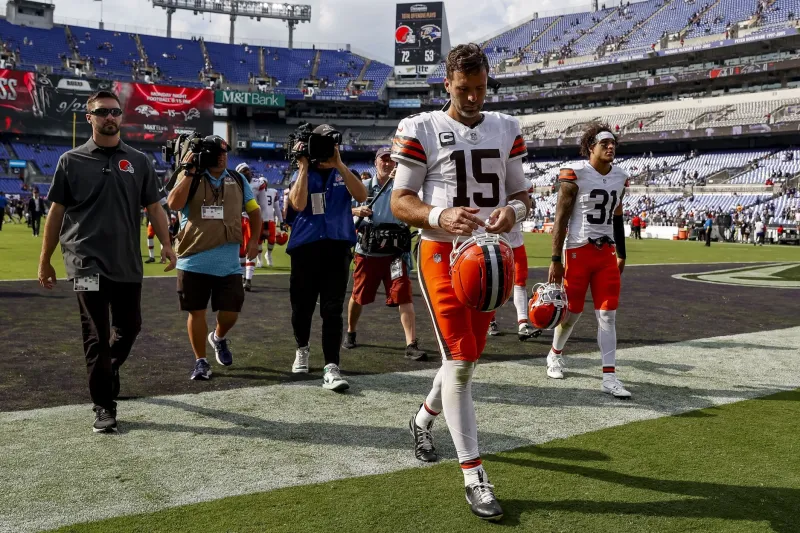
Photo: NFL quarterback walking off field facing stadium crowd, via statico.profootballnetwork.com
Somewhere in the four hours before every NFL Sunday, a graphics package gets built. It's got two headshots, a red arrow between them, and a chyron that reads something like "REVENGE GAME?". The ex-QB returns to his old stadium. The fired coach faces the franchise that let him go. The broadcast tells you this man has circled this date on his calendar since March.
Here at ScoreCast, we circled something else: the spread. Because when you actually track how "revenge games" perform against the number, the story starts to fall apart fast.
What the Data Says When You Strip the Drama
We pulled a decade's worth of matchups where the pregame narrative centered on a player or coach facing his former team — the classic revenge setup. Then we compared how those teams performed against the spread versus how they performed in comparable, non-narrative games.
The result? Basically noise. Teams playing under a revenge spotlight covered at a rate that's statistically indistinguishable from their baseline. Quarterbacks facing their former clubs didn't magically outperform their season averages. Coaches returning to old buildings didn't unlock some hidden tactical edge.
The reason is simple, and it's the part the highlight shows never mention: the market already knows the story. Oddsmakers aren't surprised that a quarterback used to play for the other team. That information was priced into the line the moment the schedule came out. Motivation, to the extent it exists, is baked in before you can even bet on it.
Why the Narrative Persists Anyway
If revenge games don't move the needle, why does the storyline survive? Because it's good television, and because human brains are wired for stories over spreadsheets.
There's a well-documented bias in how we process performance. When a player torches his old team, we remember it vividly and credit the emotion. When he plays an ordinary game against them — which is what happens the vast majority of the time — nobody writes a retrospective. The narrative survives on survivorship bias: we only count the highlight-reel confirmations and quietly forget the dozens of duds.
There's also a supply chain problem. Broadcasters need angles. Fantasy shows need segments. A Sunday between a 4-3 team and a 5-2 team doesn't sell itself; "he spent four years in that locker room" does. None of that is malicious — it's just content. The trouble starts when bettors mistake content for signal.
The Casual Bettor's Trap
Here's where the emotional angle gets expensive. Narrative-heavy games tend to attract recreational money on the revenge side. Casual bettors hear all week that the ex-QB is "locked in" and hammer his team, pushing the line a half-point or a full point in the wrong direction.
That means the other side — the team with no storyline, just a roster and a game plan — is often getting a slightly better number than it deserves. If you're looking for an edge in these spots, history suggests you look at the boring side of the hyped matchup, not the one with the documentary crew.
A Framework: When Emotion Actually Matters
None of this means motivation is always irrelevant. It means motivation only has betting value when it's not already priced in. A few filters worth running before you back any emotional storyline:
- Is this a public narrative or a quiet one? A revenge game on Sunday Night Football is fully priced. A backup linebacker facing his old team on a random 1 PM kickoff? Nobody's adjusting for that — but it's also too small to matter much.
- Does the emotion change the game plan? Motivation that doesn't alter play-calling, snap counts, or aggression is just mood. A coach who might actually go for it on fourth down more often against his old employer? That's a measurable behavior change. A receiver being "extra focused" is not.
- Is there a situational edge hiding underneath? Sometimes the real angle in a revenge game isn't the revenge — it's that the returning team is also on a short week, or off a divisional grudge match, or dealing with travel. If the only reason you like a side is the storyline, you don't like a side. You like a story.
The Bottom Line
"He wants it more" is a great premise for a feature segment and a terrible foundation for a wager. Professional bettors learned long ago that the market doesn't pay for effort — it pays for edges the number hasn't absorbed yet. And by the time the revenge graphic hits your screen, this one's been absorbed for weeks.
So the next time a broadcast spends two minutes on the homecoming angle, enjoy it. Then check the line movement, ask who the public is hammering, and consider whether the team with nothing to prove is quietly getting the better number.
The scoreboard doesn't know how anyone feels. That's exactly why the books love the narrative — and why you shouldn't bet on it.